
Hi, I'm Glen M.. I live in Nevada.
Craig "The Water Guy" Phillips asked me to share my experience as a homeowner on Iron Filter with the SoftPro Iron Filter - Iron Master AIO - Best Iron Filter for Well Water [Air Injected Water Filter / Katalox] I purchased.
This is how my adventures played out. I hope this helps you in your decision.
Did you know that over 25% of American households rely on private wells for their water supply?
If you're among them, you've probably dealt with the frustration of iron-stained fixtures, metallic-tasting water, and that distinctive reddish-brown discoloration that seems to appear everywhere water touches.
That was exactly my situation here in Nevada. After years of scrubbing orange stains from my toilets, replacing prematurely rusted appliances, and fielding complaints from my family about the taste of our water, I knew I had to find a real solution.
When I discovered the SoftPro Iron Master AIO system, I was cautiously optimistic. The promise of comprehensive iron removal through air injection and Katalox media sounded impressive, but I'd been disappointed by water treatment promises before.
After eight months of daily use, I'm ready to share the complete truth about living with this system – the good, the challenging, and everything in between. This isn't a sales pitch; it's an honest account of what you can realistically expect if you're considering this investment for your own home.
The Iron Problem That Drove Me to Action
Living in Nevada, our well water has always been a mixed blessing. We're fortunate to have a reliable water source on our property, but the mineral content tells the story of our desert geology – and iron is a major character in that story.
My water tested at 3.2 parts per million (PPM) of iron, which might not sound like much, but the EPA's secondary standard recommends no more than 0.3 PPM for aesthetic reasons. That means our water had more than ten times the recommended level.
The daily reality was exhausting. Every morning, I'd find new rust stains in the shower. The toilet bowls developed persistent orange rings that required weekly scrubbing with specialized cleaners. Our white laundry gradually took on a dingy, yellowish tint that no amount of bleach could reverse.
But the real wake-up call came when our tankless water heater started failing after just three years.
The technician pulled out heat exchanger coils that looked like they'd been soaking in rust water for decades. The iron buildup had reduced efficiency so dramatically that our utility bills had crept up by nearly 30% over two years.
Beyond the practical issues, there was the embarrassment factor. When guests visited, I found myself preemptively explaining the water quality, apologizing for the metallic taste in their coffee, and hoping they wouldn't notice the stained fixtures.
I'd tried basic sediment filters and even a relatively expensive whole-house carbon system, but these approaches only addressed taste and odor – they did nothing for the iron content. The problem wasn't just particles you could strain out; it was dissolved ferrous iron that required oxidation and specialized filtration media to remove effectively.
Research Phase: Understanding What I Actually Needed
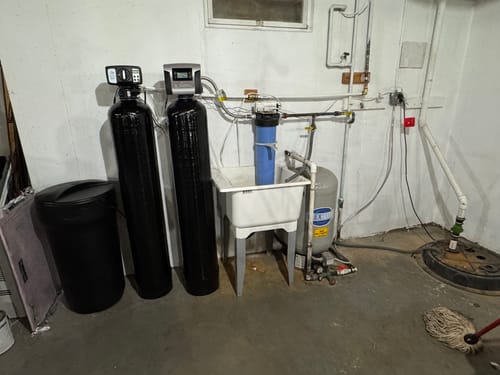
After the water heater incident, I committed to solving this problem permanently. I spent weeks researching iron removal technologies, and the learning curve was steeper than I'd expected.
I discovered that iron exists in water in two primary forms: ferrous (dissolved) and ferric (particulate). Most of our iron was ferrous – invisible to the naked eye but revealed through testing. This dissolved iron only becomes visible when it oxidizes upon contact with air, which is why our water looked clear coming from the tap but left stains everywhere it dried.
The solution requires a two-step process: oxidation to convert ferrous iron to ferric iron, followed by filtration to remove the now-particulate iron. I researched several approaches:
Chemical oxidation systems use chlorine or potassium permanganate to oxidize iron, followed by filtration and dechlorination. While effective, these systems require ongoing chemical purchases and careful monitoring.
Air injection systems use atmospheric oxygen to oxidize iron naturally, eliminating the need for chemicals. The SoftPro Iron Master uses this approach, combined with Katalox media that enhances both oxidation and filtration.
Greensand filters represent older technology that requires potassium permanganate regeneration. While proven, they involve more maintenance and chemical handling than I wanted to manage.
The Iron Master's air injection approach appealed to me for several reasons. First, it eliminates ongoing chemical costs and the complexity of chemical feed systems. Second, the Katalox media provides both catalytic oxidation enhancement and physical filtration in a single vessel.
Sizing was another crucial consideration. With four family members and typical household water usage patterns, I needed a system that could handle peak demand without pressure loss. The Iron Master's flow rate specifications and backwash requirements aligned well with our 1-inch main line and septic system capacity.
Unboxing and First Impressions
The Iron Master arrived via freight delivery, which was necessary given the size and weight of the complete system. The packaging was professional-grade – heavy-duty cardboard with foam inserts that protected each component during shipping.
Opening the boxes revealed the main filter tank, control head, air injection assembly, and various plumbing connections. My first impression was positive: the components felt substantial and well-manufactured. The filter tank itself is a standard 10-inch by 54-inch fiberglass vessel, but the control head and air injection system set this apart from basic filters.
The control head features a digital display and programming interface that looked more sophisticated than I'd expected. The air injection pump assembly included clear tubing, check valves, and mounting hardware – everything needed for a complete installation.
Documentation quality exceeded my expectations. The installation manual included detailed diagrams, plumbing schematics, and programming instructions. More importantly, it explained the theory behind the system's operation, which helped me understand what I was installing and why each component mattered.
One pleasant surprise was the inclusion of a water test kit for before-and-after verification. While I'd already had professional testing done, having the ability to monitor performance over time would prove valuable.
The only minor disappointment was the length of the included bypass valve – I needed to purchase additional fittings to accommodate our existing plumbing configuration. This wasn't a flaw in the system, just a reality of custom installations.
Installation Experience: More Complex Than Expected

I pride myself on handling most home maintenance projects, but the Iron Master installation pushed my plumbing skills to their limits. The system requirements go beyond basic filter replacement – you're essentially integrating a water treatment plant into your home's infrastructure.
The installation required several preparatory steps. First, I had to install a dedicated electrical outlet near the treatment location for the air pump and control head. Second, the system needs a drain connection for backwash cycles, which meant running a new drain line to our utility sink.
The air injection component added complexity I hadn't fully anticipated.
The system draws air from the atmosphere, injects it into the water stream, then separates the air in a specialized tank before filtration. This requires careful attention to air pump placement, tubing routing, and pressure relief.
Installing the main filter tank was straightforward – standard inlet and outlet connections with a bypass valve for maintenance. However, programming the control head required patience and multiple references to the manual. The system needs to know your water usage patterns to optimize backwash timing and frequency.
I encountered one significant challenge during startup. The initial air injection rate was too aggressive, causing water hammer issues throughout the house. After consulting SoftPro's technical support, I learned to adjust the air flow gradually while monitoring system pressure. This fine-tuning process took several days to perfect.
The total installation time was about eight hours spread across a weekend, not including the preliminary electrical and drain work. A professional installer could probably complete this in four to six hours, but the DIY approach saved approximately $400-500 in labor costs.
First startup was exciting and nerve-wracking. The system filled, began its automatic air injection cycle, and started the initial backwash sequence. Watching rust-colored water flow from the drain during that first backwash was both satisfying and slightly alarming – seeing the iron content that had been flowing through our house for years.
Performance Testing and Real Results
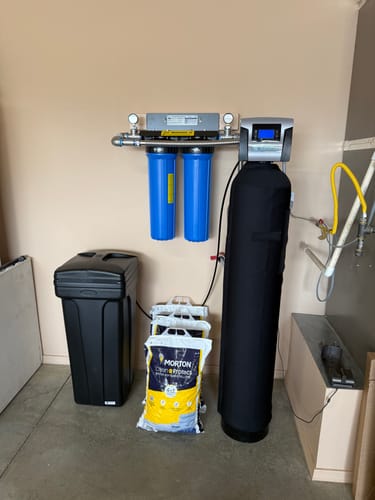
The true test of any water treatment system isn't what happens during installation – it's how it performs day after day under real household conditions. I've now monitored the Iron Master's performance for eight months, and the data tells a compelling story.
Baseline testing before installation showed iron levels at 3.2 PPM, with occasional spikes to 4.1 PPM during heavy rainfall when our well experienced surface infiltration. Post-installation testing consistently shows iron levels below 0.1 PPM – well within EPA aesthetic guidelines and practically undetectable.
The improvement wasn't just measurable; it was immediately visible. Within 48 hours of startup, new staining stopped appearing. The metallic taste that had characterized our water for years disappeared completely. Coffee and tea brewed with the treated water revealed flavors I hadn't experienced in our kitchen for years.
I conducted several specific performance tests over the following months:
Peak demand testing: Running multiple fixtures simultaneously (shower, dishwasher, washing machine) showed no pressure loss attributable to the Iron Master system. Flow rate remained consistent at 12 GPM during peak usage periods.
Regeneration efficiency: The automatic backwash cycles occur every three days based on our usage patterns, consuming approximately 150 gallons per cycle. This represents about 2% of our total water usage – acceptable overhead for the treatment benefits.
Seasonal variation testing: Nevada's monsoon season provides an annual test of system resilience. During heavy rains, our well typically sees increased iron content and turbidity. The Iron Master handled these seasonal spikes without performance degradation or required intervention.
Long-term consistency: Monthly testing over eight months shows remarkably stable performance. Iron removal efficiency hasn't declined, and the system maintains consistent pressure and flow characteristics.
Perhaps most importantly, secondary benefits emerged that I hadn't fully anticipated. Our appliances are performing better – the dishwasher leaves spots-free glassware, the washing machine requires less detergent for equivalent cleaning, and our new water heater maintains its efficiency ratings.
Daily Living Impact and Family Experience
Numbers and technical performance only tell part of the story. The real value of any home improvement project is how it affects daily life, and the Iron Master has delivered improvements that extend far beyond iron removal statistics.
The most immediate change was in our cleaning routine. Tasks that previously required specialized rust-removal products and significant scrubbing now involve basic household cleaners and minimal effort. My wife mentioned that bathroom cleaning time has been cut nearly in half – no more weekly battles with iron stains.
Laundry results improved dramatically. White items stay white, and colored fabrics maintain their vibrancy longer. We've eliminated the iron-removal additives that were a regular part of our laundry routine, and clothes feel softer coming from the washer. The soap scum that previously built up quickly in showers filter for iron now forms much more slowly and removes easily.
Personal comfort changes surprised me. Showering with iron-free water leaves skin feeling less dry and hair more manageable. While these effects are subtle and may be partially psychological, they're consistently noticeable and appreciated by all family members.
Kitchen activities benefit significantly. Ice cubes are crystal clear instead of cloudy, and beverages taste as intended. Cooking water boils to a clear consistency, and pasta water doesn't develop the slight discoloration we'd grown accustomed to. Even our coffee maker performs better – no more mineral buildup requiring monthly descaling.
Guests notice the difference immediately. Friends who regularly visit commented on the improved water taste within weeks of installation. One neighbor, who'd been dealing with similar iron issues, asked for a tour of our system after noticing the transformation in our guest bathroom.
The psychological relief shouldn't be underestimated. There's genuine peace of mind in knowing our water quality meets standards, that our appliances are protected from iron damage, and that we're not constantly fighting stains and buildup throughout the house.
Operational Costs and Long-Term Ownership
Understanding the true cost of ownership requires looking beyond the initial purchase price to include ongoing operational expenses, maintenance requirements, and potential savings from reduced appliance damage and cleaning product usage.
The Iron Master's operational costs are primarily electrical and water consumption for the backwash cycles. The air injection pump draws approximately 50 watts continuously, adding roughly $4-5 per month to our electric bill. Backwash cycles consume about 150 gallons every three days, representing approximately $12-15 monthly in water and sewer costs at our local rates.
Maintenance costs remain minimal eight months into ownership. The Katalox media is designed to last 8-10 years under normal conditions, with replacement media costing approximately $200-300 when that time comes. The control head includes a five-year warranty, and the tank itself should provide decades of service with proper maintenance.
However, the cost equation includes significant savings that offset operational expenses. We've eliminated rust-removal cleaning products that previously cost $20-30 monthly. Reduced soap and detergent usage saves another $10-15 monthly, as iron-free water allows cleaning products to work more efficiently.
Appliance protection provides the largest long-term value. Our previous tankless water heater failed after three years due to iron buildup, requiring a $1,200 replacement. Protecting our current unit alone justifies a significant portion of the Iron Master's cost over its expected lifespan.
Energy efficiency improvements are measurable. Our new water heater operates at rated efficiency without iron interference, and our dishwasher completes cycles more effectively without mineral buildup reducing spray arm performance. While difficult to quantify precisely, these efficiency gains contribute to overall household utility savings.
Calculating return on investment, the Iron Master pays for itself within 3-4 years through combined savings and avoided appliance replacement costs. Beyond that payback period, the system continues generating value through improved water quality and ongoing protection benefits.
Honest Assessment: Limitations and Considerations
After eight months of ownership, I can provide a balanced perspective on the Iron Master's limitations and situations where potential buyers should carefully consider their specific needs and circumstances.
The system requires significant space installation. The main tank, air injection assembly, and associated plumbing occupy approximately 4 feet by 2 feet of floor space, plus clearance for maintenance access. Homes with limited utility space may find installation challenging without relocating other equipment.
Electrical requirements add complexity and cost if your treatment location lacks nearby outlets. The air pump and control head need dedicated power, preferably on a circuit that won't be affected by frequent basement or garage electrical issues. Installation may require professional electrical work in some situations.
The backwash cycles produce significant water usage that may concern households on private wells or those paying high sewer costs. While 150 gallons every few days isn't excessive for most homes, it represents real ongoing consumption that affects utility bills and septic system loading.
Noise levels, while minimal, are noticeable during backwash cycles and when the air pump operates. The system isn't silent – you'll hear water flowing during regeneration and a subtle humming from the air injection pump. Installation near living spaces requires consideration of these operational sounds.
Complex water chemistry situations may require additional treatment components. Homes with high pH, hydrogen sulfide, or multiple contaminants might need pre-treatment or supplemental systems. The Iron Master addresses iron effectively but isn't a comprehensive solution for all water quality issues.
DIY installation, while possible, requires genuine plumbing skills and comfort with complex systems. This isn't a simple filter replacement – it's a sophisticated treatment system that demands careful installation and programming for optimal performance. Professional installation adds $400-600 to project costs but ensures proper setup.
Maintenance, though minimal, requires ongoing attention. Monthly system checks, annual testing, and eventual media replacement represent long-term commitments that some homeowners prefer to avoid.