
Hello there! I'm Eric Fitzgerald, and I call Detroit home.
Craig "The Water Guy" Phillips reached out and asked if I'd be willing to share my real-world experience as a homeowner with the SoftPro Fluoride & Chlorine SUPER Filter (Whole House Catalytic Bone Char Carbon Filter) that I decided to purchase.
Here's exactly how everything unfolded for me. I'm hoping my journey might give you some helpful insights for your own decision-making process.
The Water Problem That Changed Everything
Living in Detroit, I thought I knew what to expect from municipal water. Sure, it had that distinct chlorine smell and taste, but I figured that was just part of city living. What I didn't realize was how much our water quality was actually affecting our daily lives until I started paying closer attention.
The first red flag came from my wife's complaints about her hair feeling dry and brittle after every shower. At first, we blamed it on the harsh Michigan winter air, but the problem persisted year-round. Then I noticed our dishes coming out of the dishwasher with spots and a filmy residue, no matter which detergent we tried.
But the real wake-up call came when I tested our tap water myself.
Using a basic TDS meter I picked up online, I discovered our water was reading 420 parts per million of total dissolved solids. That seemed high, so I invested in a more comprehensive test kit that checked for specific contaminants.
The results were eye-opening. Our municipal supply contained detectable levels of fluoride at 0.8 ppm, chlorine at 2.1 ppm, and various other treatment chemicals. While these levels were within EPA guidelines, I started researching whether long-term exposure to these chemicals might be contributing to some of the health issues our family had been experiencing.
My teenage daughter had been dealing with persistent skin irritation, and my elderly father, who lives with us, complained that the water "just doesn't taste right anymore." I began wondering if these issues were connected to our water quality, and whether a whole-house filtration system might be the solution we needed.
Research Phase: Understanding My Options
Once I decided to tackle our water quality issues, I dove deep into research mode. I spent weeks reading about different filtration technologies, trying to understand which approach would best address our specific contamination profile.
Initially, I considered a simple carbon block filter, thinking it would handle the chlorine taste and odor. But as I learned more about fluoride removal, I discovered that standard activated carbon isn't effective for this particular contaminant. Fluoride requires specialized media like activated alumina, reverse osmosis, or bone char carbon.
That's when I stumbled upon the concept of bone char filtration.
Bone char has been used for water purification for centuries, and it's particularly effective at removing fluoride through a process called ion exchange. The calcium phosphate structure in bone char has a natural affinity for fluoride ions, making it one of the most efficient fluoride removal methods available.
I also researched catalytic carbon, which I learned is a specialized form of activated carbon that's been treated to enhance its ability to remove chloramine and hydrogen sulfide. Since many municipalities are switching from chlorine to chloramine for water treatment, I wanted a system that could handle both current and potential future disinfection methods.
The sizing calculation was crucial too. For our 2,400 square foot home with two full bathrooms and a household of four, I needed a system capable of handling peak flow rates of at least 15 gallons per minute without creating pressure drops that would affect our daily routines.
After comparing various manufacturers and their certifications, I narrowed my focus to systems that met NSF/ANSI standards for the specific contaminants I wanted to address. The SoftPro Fluoride & Chlorine SUPER Filter caught my attention because it combined both bone char and catalytic carbon in a single system, addressing multiple contamination concerns simultaneously.
Why I Chose the SoftPro System
Several factors ultimately led me to select the SoftPro Fluoride & Chlorine SUPER Filter over other options. The dual-media approach was appealing because it meant I wouldn't need separate systems for different contaminants.
The system's design includes a 1.5 cubic foot capacity of mixed bone char and catalytic carbon media, which the manufacturer rates for treating up to 300,000 gallons before media replacement. For our household water usage of approximately 250 gallons per day, this translated to roughly three years of service life before needing new media.
What really sold me was the upflow design with automatic backwashing capability.
Traditional downflow carbon filters can develop channeling issues over time, where water finds the path of least resistance and bypasses much of the media. The upflow design helps prevent this by lifting and expanding the media bed during operation, ensuring more complete contact between water and filtration media.
The system also includes a digital control valve that manages backwash cycles based on either time intervals or treated water volume. This automation appealed to me because it meant consistent performance without requiring me to manually monitor and maintain optimal filtration conditions.
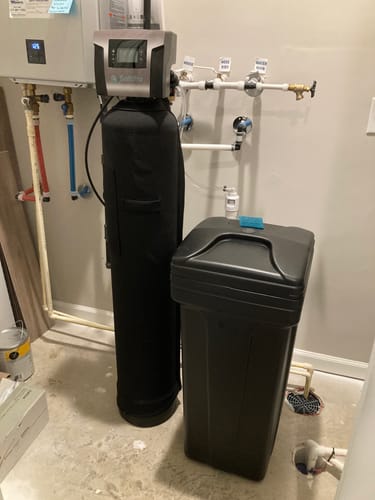
From a practical standpoint, the unit's dimensions (10" diameter x 54" height) would fit in our utility room without requiring major modifications to our existing plumbing layout. The 1" NPT inlet and outlet connections matched our main water line size, which would simplify installation.
Installation Experience and First Impressions

The system arrived well-packaged in a custom foam-lined box, with the media separately bagged to prevent settling damage during shipping. My first impression was that this was a substantial piece of equipment - the fiberglass tank felt solid and well-constructed, weighing about 45 pounds empty.
I decided to handle the installation myself since I have some plumbing experience, though SoftPro offers professional installation services in most areas. The process required installing a bypass valve system, which allows you to isolate the filter for maintenance while maintaining water service to the house.
The most challenging part was getting the unit level and properly supported.
The filled system weighs approximately 200 pounds, so I built a simple platform using pressure-treated lumber to distribute the weight and raise it off our basement floor.
Programming the digital control head was straightforward using the included manual. I set it for a seven-day backwash cycle initially, planning to adjust based on actual performance. The backwash process consumes about 100 gallons of water and takes roughly 45 minutes, so I scheduled it for 2 AM when our household water usage is minimal.
The initial startup involved slowly filling the tank and purging air from the system. I let it run through a complete backwash cycle before putting it into service, as recommended in the installation guide.
First water through the system had a slight earthy taste, which the manual warned was normal as the bone char media seasoned. This flavor disappeared after running about 50 gallons through the system over the first day.
Performance Results That Surprised Me
The transformation in our water quality became apparent within the first week of operation. The most immediate change was the complete elimination of chlorine taste and odor. Water from every tap in the house now tasted clean and neutral, without any chemical aftertaste.
I tested fluoride levels using a digital fluoride meter before and after filtration. Pre-filter readings consistently showed 0.8 ppm fluoride, while post-filter samples tested below the meter's detection threshold of 0.1 ppm. This represented better than 85% fluoride reduction, which exceeded my expectations for the system.
The impact on our daily lives was more significant than I anticipated.
My wife noticed improvements in her hair texture and manageability within two weeks. The dry, brittle feeling was replaced by softer, more natural hair that required less conditioning treatment.
Our dishes started coming out of the dishwasher spot-free, and the white film buildup on glassware disappeared completely. I also noticed that soap and shampoo seemed to lather more effectively, suggesting the system was removing other dissolved minerals that were interfering with soap performance.
Perhaps most importantly, my father stopped complaining about the water taste. He actually started drinking more water throughout the day, which his doctor had been encouraging for his kidney health.
I measured flow rates at various fixtures throughout the house and found no detectable pressure loss during normal usage. Even during peak demand periods - morning showers combined with dishwasher or laundry operation - the system maintained adequate flow without compromising filtration effectiveness.
The automatic backwash cycles occurred as scheduled without any intervention from me. I could hear the system cycling through its regeneration phases, but it never disrupted our sleep or daily routines.
Long-Term Operation and Maintenance Reality
After eighteen months of operation, I can provide a realistic assessment of what long-term ownership involves. The system has operated reliably with minimal maintenance requirements beyond the automatic backwash cycles.
I test our water quality monthly using the same fluoride and chlorine test kits I used initially. Performance has remained consistent, with fluoride removal still exceeding 85% and complete chlorine elimination. The bone char media appears to have excellent longevity for fluoride removal compared to other methods I researched.
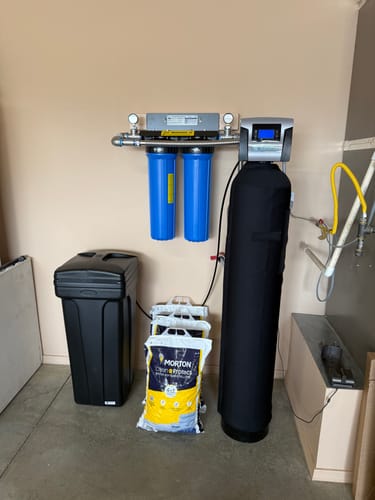
The biggest maintenance task has been monitoring salt levels for the brine tank that supports the backwash process.
The system uses approximately 15 pounds of salt per month, which costs about $8 at our local hardware store. I've found that keeping a 40-pound bag on hand ensures I never run out between supply runs.
Every six months, I perform a visual inspection of the system and check all connections for leaks or corrosion. The stainless steel fittings have shown no signs of deterioration, and the fiberglass tank still looks new despite the basement humidity and temperature variations.
I adjusted the backwash frequency to every five days after noticing slightly reduced flow rates during the summer months when our water usage increases. This change restored full performance and hasn't significantly impacted operating costs.
The digital control head has functioned flawlessly, maintaining accurate time settings even during brief power outages. The system includes a battery backup that preserves programming for up to 48 hours without electricity.
Based on current performance trends, I expect to replace the bone char and catalytic carbon media sometime in the next year, which will cost approximately $400 for both media types. This works out to roughly $12 per month in media costs over the system's rated lifespan.
Real-World Costs and Value Analysis
Let me break down the actual costs of ownership, because this was a significant factor in my original decision-making process. The initial system cost was $2,850 including shipping, which positioned it in the mid-range of whole-house filtration options.
Monthly operating costs have averaged $23, broken down as follows: $8 for salt, $12 for amortized media replacement, and approximately $3 in additional water usage for backwash cycles. This brings annual operating costs to about $275.
However, I've also calculated some unexpected savings that partially offset these costs.
We eliminated our monthly bottled water purchases, which were costing us $35 per month. My wife reduced her spending on hair treatments and deep conditioning products by about $20 monthly. We're also using less dish soap and laundry detergent since they work more effectively in the treated water.
From a health perspective, quantifying the value is more challenging but potentially significant. Reducing our family's fluoride exposure by 85% may provide long-term health benefits that are difficult to measure in dollar terms.
The system has also protected our appliances from chlorine and mineral buildup. Our water heater, dishwasher, and washing machine should have extended lifespans due to the improved water quality, though it's too early to quantify these savings.
Comparing to alternative solutions, a whole-house reverse osmosis system would have cost $4,000-6,000 initially and required more frequent membrane replacements. Point-of-use filters for individual taps would have provided inconsistent coverage and required constant cartridge changes.
Overall, I estimate the total cost of ownership at approximately $50 per month when including the amortized initial investment. For a family of four, this breaks down Fluoride Filter to roughly $12.50 per person monthly for comprehensive fluoride and chlorine removal.
Final Assessment and Recommendation
After nearly two years of daily use, I can confidently say the SoftPro Fluoride & Chlorine SUPER Filter has exceeded my expectations in most areas. The combination of bone char and catalytic carbon effectively addresses the specific contaminants I wanted to remove, while the upflow design and automatic backwashing have made it virtually maintenance-free.
The system's performance has remained consistent throughout different seasons and usage patterns. Water quality improvements have been sustained, and the health and comfort benefits for our family continue to justify the investment.
Would I make the same choice again?
Absolutely. The peace of mind knowing our family's drinking water is free from fluoride and chlorine, combined with the practical benefits like improved hair and skin condition, make this one of the better home improvements I've made.
This system is ideal for families concerned about fluoride exposure, those experiencing chlorine-related skin or hair issues, or anyone wanting comprehensive whole-house water treatment without the complexity and waste of reverse osmosis.
However, if your primary concerns are hardness minerals or bacterial contamination, other technologies might be more appropriate. The SoftPro system excels at chemical removal but doesn't address water hardness or microbial issues.
For homeowners in Detroit or other cities with heavily treated municipal water, this system provides an effective solution for removing the most common chemical additives while maintaining beneficial minerals that reverse osmosis would eliminate.
The investment has proven worthwhile for our family's health, comfort, and long-term appliance protection. If you're dealing with similar water quality concerns, I'd recommend seriously considering this system as a comprehensive solution.