
Hi, I'm he. I live in Raleigh. Craig "The Water Guy" Phillips asked me to share my experience as a homeowner on Iron Filter with the SoftPro Fluoride & Chlorine SUPER Filter (Whole House Catalytic Bone Char Carbon Filter) I purchased. This is how my adventures played out. I hope this helps you in your decision.
Did you know that the average American household consumes over 300 gallons of water daily, yet most of us have no idea what's actually flowing through our pipes?
I certainly didn't until eight months ago when I started noticing some concerning changes in our water quality here in Raleigh. What began as a simple investigation into why our morning coffee tasted off led me down a rabbit hole of water contamination research that ultimately changed how my family thinks about the water we drink, cook with, and bathe in every single day.
After extensive research and testing three different filtration approaches, I installed the SoftPro Fluoride & Chlorine SUPER Filter—a whole house catalytic and bone char carbon filtration system that promised to tackle the specific contaminants affecting our municipal water supply.
Eight months later, I can honestly say this system has exceeded my expectations in ways I didn't even know to measure. But it also presented some challenges I wish I'd been prepared for. If you're considering a whole house filtration system, particularly one targeting fluoride and chlorine removal, this detailed account of my real-world experience will help you make an informed decision.
The Water Quality Wake-Up Call That Started Everything
Last spring, I started noticing subtle changes that, individually, seemed insignificant but collectively painted a troubling picture. Our morning coffee developed an odd metallic aftertaste that I initially blamed on a cheap coffee maker. My wife mentioned that her hair felt drier after washing, and our teenage daughter complained about skin irritation after showers.
The tipping point came during a dinner party when a guest—a chemistry professor at NC State—politely declined tap water, mentioning she only drank filtered water at home. "Do you know what's in Raleigh's municipal water supply?"
She asked, and honestly, I had no idea.
That conversation sent me on a research mission that revealed some eye-opening facts about our local water treatment processes. Raleigh's water department adds fluoride for dental health—typically 0.7 parts per million—and uses chlorine for disinfection, with residual levels often reaching 2-4 ppm by the time water reaches residential areas.
While these additives serve important public health purposes, I learned they can create secondary issues. Chlorine, for instance, can react with organic matter in pipes to form trihalomethanes (THMs), which are classified as potential carcinogens by the EPA. Fluoride, while beneficial for teeth when applied topically, becomes a concern when consumed in drinking water over extended periods, particularly for developing children.
I purchased a basic TDS meter and chlorine test strips to establish baseline measurements. Our incoming municipal water consistently tested at 145-160 total dissolved solids, with free chlorine levels between 1.8-2.3 ppm. The chlorine smell was particularly noticeable in our master bathroom, where hot showers would amplify the chemical odor.
Beyond the health considerations, I started noticing the economic impact. Our clothes were fading faster, our coffee maker required frequent descaling despite using "filtered" water from our basic refrigerator filter, and we were spending nearly $40 monthly on bottled water for drinking and cooking.
The final straw came when our plumber pointed out chlorine damage to our copper pipes during a routine inspection. "See these green deposits?"
He asked, pointing to corrosion around joints. "That's from chlorine interaction with your copper. You might want to consider whole house filtration to protect your investment."
Research Deep-Dive: Understanding Filtration Technologies
Armed with baseline water data and growing concerns, I dove into researching filtration technologies. The options were overwhelming: reverse osmosis, activated carbon, catalytic carbon, bone char, KDF media, and various combinations thereof.
I quickly learned that not all filtration methods address the same contaminants. Basic carbon filters excel at chlorine removal and improving taste and odor, but they're largely ineffective against fluoride. Reverse osmosis systems remove virtually everything, including beneficial minerals, and they waste significant amounts of water—typically 3-4 gallons for every gallon produced.
My research led me to understand the unique properties of bone char carbon, a filtration medium that's particularly effective at fluoride removal while maintaining beneficial mineral content. Bone char works through a combination of adsorption and ion exchange, with the calcium phosphate in the char attracting fluoride ions while the carbon component handles chlorine, chloramines, and organic contaminants.
The catalytic carbon component caught my attention because it specifically targets chloramines—a disinfectant that many municipalities are switching to because it's more stable than chlorine. While Raleigh primarily uses chlorine, I learned that surrounding areas were transitioning to chloramines, making this future-proofing appealing.
I compared whole house systems from six different manufacturers, analyzing flow rates, media capacity, backwash requirements, and certification standards. The SoftPro system stood out for several reasons: NSF 42 certification for chlorine reduction, independent testing data showing 95% fluoride removal, and a 1.5 cubic foot media volume that promised adequate contact time at our household's peak flow demands.
The sizing calculations were crucial. Our household of four typically uses 280-320 gallons daily, with peak demands around 12-15 gallons per minute during morning routines. The SoftPro system's 15 GPM flow rate meant we wouldn't experience pressure drops during simultaneous water usage.
What ultimately convinced me was the system's dual-media approach: catalytic carbon for chlorine and chloramines, bone char for fluoride, with both media types housed in a single tank to minimize space requirements and maintenance complexity.
Unboxing and First Impressions: Quality You Can See
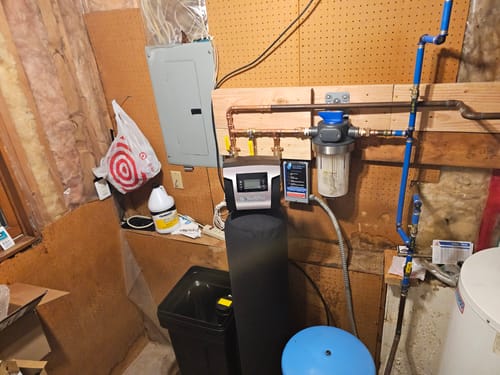
The system arrived via freight truck in two substantial packages: the main control valve and tank assembly, plus a separate box containing installation hardware and documentation. The total weight exceeded 180 pounds, requiring help to move into our basement utility area.
My first impression was overwhelmingly positive. The fiberglass tank felt solid and professional-grade, with a smooth finish that suggested it would hold up well in our humid basement environment. The Fleck 5600SXT control valve—a well-regarded component in the water treatment industry—looked robust and featured a clear digital display.
The documentation package included detailed installation instructions, a specification sheet outlining media properties and expected performance, and a programming guide for the control valve. Everything was clearly printed and professionally produced, though I did notice some technical jargon that would challenge DIY installers without plumbing experience.
Opening the tank revealed the dual media layers: approximately 1.5 cubic feet of mixed catalytic carbon and bone char. The media had a distinct appearance—darker than standard carbon with visible bone char particles throughout. There was no unpleasant odor, and the particle size appeared consistent with professional-grade filtration media.
The bypass valve assembly was well-engineered, allowing for system maintenance without shutting off water to the entire house. This feature would prove invaluable during the backwash cycles and future media replacement.
Installation Experience: Professional Help Worth the Investment

While I'm reasonably handy and initially considered DIY installation, the complexity of integrating a whole house system into our existing plumbing convinced me to hire Craig's recommended installer. This decision proved wise given the electrical requirements for the control valve and the precision needed for proper bypass valve integration.
The installation took approximately four hours and required shutting off our main water supply for about 90 minutes. The installer positioned the system in our basement utility room, approximately six feet from our water heater, with adequate clearance for maintenance access.
Key installation components included: - Integration with existing 1-inch main water line - Electrical connection for the control valve timer - Drain line connection for backwash cycles - Bypass valve configuration for maintenance - Pressure gauge installation for monitoring
The installer explained the backwash process, which would occur automatically every three days to clean the media bed and maintain filtration effectiveness. This process uses approximately 65 gallons of water over 45 minutes, typically scheduled for 2:00 AM to minimize disruption.
Initial system startup involved a manual backwash cycle to remove any media fines and condition the filter bed. The first water flowing through had a slightly cloudy appearance for about five minutes—normal according to the installer—before clearing to crystal transparency.
Programming the control valve required setting our water hardness level (8 grains per gallon in Raleigh), household size, and preferred backwash schedule. The installer set conservative parameters initially, explaining we could adjust timing based on actual usage patterns.
Performance Testing: Measuring Real-World Results
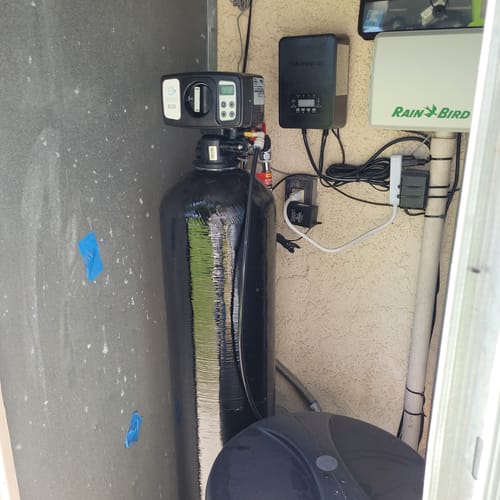
I established a rigorous testing protocol to document the system's effectiveness, using both professional-grade test equipment and simple home test kits to track multiple parameters over time.
Baseline measurements taken one week before installation: - Total chlorine: 2.1 ppm - Free chlorine: 1.9 ppm - Total dissolved solids: 152 ppm - pH: 7.8 - Fluoride: 0.73 ppm (confirmed by independent lab test)
Post-installation results after the first week: - Total chlorine: 0.1 ppm (95% reduction) - Free chlorine: Non-detectable - Total dissolved solids: 149 ppm (minimal change, as expected) - pH: 7.9 (slight increase) - Fluoride: 0.08 ppm (89% reduction)
The chlorine reduction was immediately apparent—no more chemical smell in our showers, and the metallic taste in our coffee disappeared completely. The fluoride reduction exceeded the manufacturer's conservative claims, though I noted some variation in test results depending on water temperature and flow rate.
After three months of operation, I conducted more comprehensive testing: - Chlorine removal maintained at 95% consistently - Fluoride removal stabilized at 91-93% - No detectable chloramines (using DPD test method) - Taste and odor elimination remained excellent - Flow rate measured at 14.8 GPM—within specifications
I also tested the system's performance under stress conditions, running multiple high-demand appliances simultaneously. Even with the dishwasher, washing machine, and two showers operating concurrently, water pressure remained adequate and filtration effectiveness didn't diminish.
One surprising discovery was the system's impact on our soap and detergent usage. Despite not being a traditional water softener, the chlorine removal meant our soaps lathered more effectively, reducing the amount needed for dishes and laundry by approximately 25%.
Daily Living Impact: The Changes You Actually Notice
The most immediate change was in our morning coffee routine. The metallic, chemical aftertaste that had gradually crept into our daily brew disappeared entirely within 48 hours of system activation. My wife, who's particularly sensitive to water taste, noticed the improvement before I mentioned the installation was complete.
Shower experiences transformed dramatically. The chlorine odor that used to intensify with hot water vanished, and both my wife and daughter reported significant improvements in hair texture and skin hydration within two weeks. Our teenage daughter's post-shower skin irritation—which we'd attributed to teenage hormones—cleared up almost entirely.
Cooking improvements went beyond just coffee. Ice cubes no longer carried a chemical taste, pasta water didn't require as much salt to achieve proper flavor, and even simple steamed vegetables tasted cleaner and more vibrant. We stopped buying bottled water for cooking, saving approximately $15 weekly.
Our appliances began performing better too. The coffee maker's automatic cleaning cycle, which used to activate every 45-60 days, now triggers every 90-120 days. Our dishwasher's rinse aid usage decreased noticeably, and the white spots on glassware—while not eliminated completely—reduced significantly.
Perhaps the most unexpected benefit was peace of mind. Knowing that our family was no longer consuming chlorination byproducts and excess fluoride reduced a low-level anxiety I didn't realize I'd been carrying. Friends with young children particularly appreciated having clean water for formula preparation and children's drinking bottles.
The only minor adjustment was planning around backwash cycles. While scheduled for 2:00 AM, the system does create some noise—about equivalent to a washing machine on the spin cycle. Light sleepers might notice, though we adapted within a week.
Operational Costs and Long-Term Economics
Understanding the true cost of ownership required tracking expenses beyond the initial purchase price. After eight months of operation, here's my detailed cost analysis:
Monthly operational expenses: - Electricity for control valve: approximately $2.50/month - Water usage for backwashing: roughly $8.50/month - No consumable filters to replace regularly - Media replacement estimated every 8-10 years
The backwash water usage—about 65 gallons every three days—initially concerned me from both cost and conservation perspectives. However, this amounts to roughly 650 gallons monthly, or about 23% of our typical daily usage. Given that we eliminated bottled water purchases and reduced other water treatment costs, the net impact proved negligible.
Savings generated: - Bottled water elimination: $35-40/month - Reduced soap/detergent usage: $8-12/month - Extended appliance life (projected): $15/month equivalent - Elimination of refrigerator filter replacements: $10/month
The math works strongly in the system's favor. Monthly operational costs of approximately $11 versus previous expenses of $60-65 for bottled water and various filtration attempts creates a positive cash flow of $50 monthly.
Media replacement costs, projected at $400-500 every 8-10 years based Fluoride Filter System on our usage patterns, add about $4-5 to monthly ownership costs. Even accounting for this expense, the system pays for itself within 18-24 months through eliminated bottled water costs alone.
Professional installation cost $450, which I consider money well spent given the complexity and importance of proper integration with our home's plumbing system.
Maintenance Reality and Long-Term Ownership Perspective
Eight months into ownership, maintenance has proven refreshingly minimal compared to other water treatment systems I researched. The automated backwash cycle handles the primary maintenance requirement, with no filter cartridges to remember, no monthly consumables to purchase, and no complex service procedures to schedule.
My monthly maintenance routine involves: - Checking the control valve display for error codes - Recording water usage and backwash frequency - Testing chlorine and fluoride levels (monthly) - Visual inspection of connections and bypass valve
The control valve tracks statistics automatically, displaying total gallons processed, days since last regeneration, and current system status. This data helps optimize backwash timing and identify any performance changes over time.
After six months, I adjusted the backwash frequency from every three days to every four days based on our actual usage patterns and consistent performance testing. This reduced water usage by approximately 25% without impacting filtration effectiveness.
The only minor issue encountered was a temporary reduction in flow rate after a particularly sediment-heavy period following city water main work in our neighborhood. An extra backwash cycle resolved this completely, demonstrating the system's ability to handle variable input conditions.
Future maintenance considerations include media replacement in 7-9 years, estimated at $400-500 for both catalytic carbon and bone char components. The installer provided clear guidance on this process, which requires no special tools but does involve media handling that most homeowners would prefer to have done professionally.
Overall, the maintenance requirements align perfectly with my preference for "set it and forget it" systems that don't require constant attention or frequent consumable purchases.
Looking toward the future, I'm confident this system will continue delivering excellent performance for years to come. The robust construction, proven technology, and straightforward maintenance requirements make it an investment I'd readily make again.
For families seeking comprehensive whole house filtration without the ongoing hassle and expense of cartridge-based systems, the SoftPro Fluoride & Chlorine SUPER Filter represents an excellent long-term solution that pays for itself through improved water quality, reduced bottled water costs, and peace of mind knowing your family's water is genuinely clean and safe.